Being a client-oriented company; we provide our clients with customized solutions for HDPE Tarpaulin & woven sacks. We can also package the products as per the specifications provided by clients to ensure safe and secure transit.
Severity: Warning
Message: session_start(): Failed to initialize storage module: user (path: /home/arorapolymers/public_html/system/sessions)
Filename: Session/Session.php
Line Number: 137
Backtrace:
File: /home/arorapolymers/public_html/application/controllers/Aashishtest.php
Line: 7
Function: __construct
File: /home/arorapolymers/public_html/index.php
Line: 317
Function: require_once
Being a client-oriented company; we provide our clients with customized solutions for HDPE Tarpaulin & woven sacks. We can also package the products as per the specifications provided by clients to ensure safe and secure transit.
Being a client-oriented company; we provide our clients with customized solutions for HDPE Tarpaulin & woven sacks. We can also package the products as per the specifications provided by clients to ensure safe and secure transit.
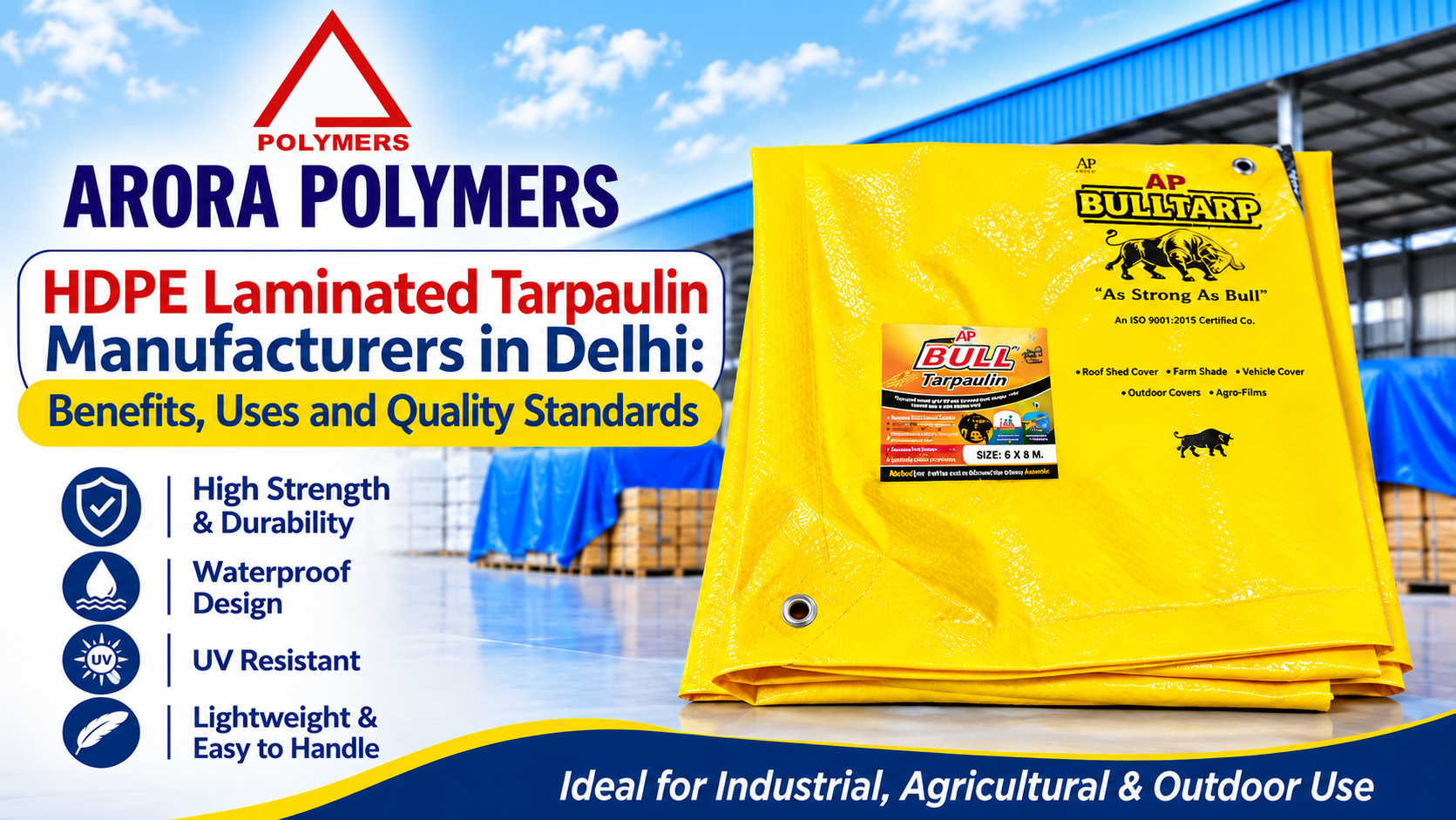
HDPE laminated tarpaulins have become an essential protective material for industries that need reliable coverage against rain, dust, sunlight and changing weather conditions. From construction sites and agricultural storage to transportation, warehouses and manufacturing facilities, these versatile sheets help protect valuable materials while offering a practical and economical covering solution.
Choosing the right HDPE Laminated Tarpaulin Manufacturers in Delhi is important for businesses that require durable products, consistent quality, customized sizes and dependable supply. A well-manufactured tarpaulin can make everyday storage and material-handling activities easier while helping reduce the risk of damage caused by environmental exposure.
Arora Polymers is a business that buyers can explore for polymer-related product requirements. Companies looking for suitable tarpaulin solutions should understand the material's construction, performance characteristics, applications and quality parameters before selecting a supplier.
In this guide, we explore the benefits of HDPE laminated tarpaulins, their applications across different industries, manufacturing processes, important quality standards and the factors buyers should consider when choosing a manufacturer.
An HDPE laminated tarpaulin is a protective sheet made using high-density polyethylene (HDPE) woven fabric with a polymer coating or laminated layer. The woven structure provides strength, while the lamination helps improve water resistance and surface protection.
These sheets are widely used for covering goods, equipment, agricultural produce, construction materials, machinery and outdoor inventory. Their lightweight construction makes them easy to carry, fold, transport and install, making them useful for both temporary and recurring covering requirements.
Unlike heavy traditional covering materials, HDPE laminated tarpaulins offer a combination of flexibility, strength and convenience. They can be manufactured in different sizes, colours, thicknesses and GSM specifications to meet the needs of different industries.
Businesses searching for HDPE Laminated Tarpaulin Manufacturers in Delhi generally require products that offer dependable protection, easy handling and good value for money. Selecting the correct material specification is essential to achieving the desired performance.
Key Features of HDPE Laminated Tarpaulins
• Water-resistant laminated surface
• Lightweight and easy-to-handle construction
• Woven fabric strength
• Flexible and foldable material
• Protection against dust, moisture and environmental exposure
• UV-stabilized options for outdoor applications
• Available in different colours, GSM and dimensions
• Suitable for industrial, commercial, agricultural and construction applications
• Custom finishing options such as reinforced edges and eyelets, subject to specifications
Businesses today require protective materials that are economical, easy to use and capable of handling everyday operational challenges. HDPE laminated tarpaulins fulfil these requirements in several industries because they can be used for covering materials in warehouses, outdoor storage areas, transportation vehicles and construction sites.
Their popularity is largely driven by their practical design. They are easy to move, convenient to store and available in specifications suitable for different covering applications.
Reliable HDPE Laminated Tarpaulin Manufacturers in Delhi can help businesses identify suitable products according to their operational requirements, storage conditions and budget.
One of the biggest advantages of HDPE laminated tarpaulins is their relatively lightweight construction. Workers can conveniently unfold, position and remove these sheets when required.
This feature is especially useful for transportation companies, warehouse operators, construction contractors and agricultural businesses that regularly move or reposition protective coverings.
The laminated surface helps reduce water penetration, making these tarpaulins suitable for covering materials that require protection from rain and moisture.
They can be used to cover agricultural produce, building materials, machinery, raw materials and other goods stored in outdoor or temporary storage areas.
Buyers looking for Waterproof HDPE Tarpaulin Manufacturers should check the product specifications and verify whether the material is suitable for the level of water exposure expected in their application.
HDPE woven fabric is designed to provide structural strength. The quality of the tapes, weaving pattern, GSM and lamination all contribute to the performance of the finished tarpaulin.
A suitable tarpaulin can withstand regular handling, folding and covering activities when used according to its intended specifications.
When not in use, tarpaulins can generally be folded and stored without occupying excessive space. This makes them practical for businesses with limited storage facilities.
With appropriate handling and maintenance, reusable tarpaulins can support multiple covering applications and help businesses reduce unnecessary material replacement.
The growing demand for HDPE laminated tarpaulin manufacturers comes from their ability to provide multiple benefits through one practical covering material.
Rain and moisture can damage many stored materials, including packaging, construction supplies, agricultural products and industrial inventory.
HDPE laminated tarpaulins help protect covered materials by reducing direct exposure to water. Their laminated surface is particularly useful for temporary and general-purpose outdoor covering applications.
Businesses comparing HDPE Laminated Tarpaulin Manufacturers in Delhi should evaluate the lamination quality and water-resistance performance rather than relying only on product appearance.
Dust can affect stored goods, machinery, raw materials and finished products. Covering these materials with a suitable tarpaulin can help reduce dust accumulation and make storage areas easier to manage.
This benefit is useful in construction sites, industrial facilities, warehouses and outdoor stockyards where materials are exposed to surrounding environmental conditions.
Tarpaulins used outdoors may be exposed to direct sunlight for extended periods. Ultraviolet radiation can gradually affect polymer materials, depending on their formulation and exposure conditions.
UV-stabilized HDPE tarpaulins are available for applications where sunlight exposure is an important consideration. Buyers should discuss their outdoor usage requirements with the manufacturer to select suitable material.
Businesses often need protective covering without investing in expensive permanent storage structures. HDPE laminated tarpaulins provide a practical solution for temporary protection and general storage applications.
Their portability, reusable nature and ease of handling can make them economical for companies with recurring covering requirements.
These tarpaulins can be used across different industries and for a wide range of purposes. They may cover irregularly shaped equipment, stockpiles, materials stored outdoors or goods transported between locations.
This versatility makes them a valuable material for businesses that need adaptable protection.
HDPE laminated tarpaulins are used in numerous sectors because they offer a convenient way to protect materials against environmental exposure.
| Industry | Common Application | Purpose |
| Agriculture | Covering crops, grains, fertilizers and feed | Reduce moisture and dust exposure |
| Construction | Covering cement, sand, equipment and building materials | Protect materials from weather |
| Transportation | Covering truck cargo and goods | Reduce exposure during transit |
| Warehousing | Outdoor stock and inventory covering | Reduce dust and moisture exposure |
| Manufacturing | Machinery and raw material covering | Reduce dust and moisture exposure |
| Infrastructure | Temporary site covering | Provide flexible protection |
| Commercial businesses | Covering stock and products | Protect goods stored outdoors |
Agricultural businesses often need to protect grains, pulses, fertilizers, seeds and other materials during storage and transportation.
HDPE laminated tarpaulins can help cover agricultural produce kept in temporary storage areas or open locations. They are also useful for covering farm equipment, agricultural supplies and materials during seasonal operations.
Farmers and distributors can select different sizes and specifications according to the amount of material being covered and the surrounding conditions.
Construction sites frequently store materials in open areas where rain, sunlight and dust can affect product quality.
Tarpaulins are commonly used to cover cement bags, sand, aggregates, construction equipment, tools and other building materials.
Contractors looking for Waterproof HDPE Tarpaulin Manufacturers can consider products with suitable dimensions, reinforced edges and fastening arrangements for site-specific applications.
Truck operators, transport companies and logistics businesses use tarpaulins to protect cargo during movement.
A properly selected covering can help reduce exposure to rain, dust, wind and sunlight. Depending on the cargo and vehicle dimensions, buyers may require larger sheets, customized sizes, reinforced edges and suitable eyelets.
Businesses searching for HDPE Laminated Tarpaulin Manufacturers in Delhi for transportation applications should consider the sheet size, fastening requirements and expected environmental exposure.
Machinery stored outdoors or in areas exposed to dust may require temporary protective covering.
HDPE laminated tarpaulins can be used to cover equipment, industrial components, spare parts, tools and machinery during storage, maintenance or relocation.
They provide a flexible alternative when a permanent enclosure is not available or practical.
Warehouses sometimes require additional space for materials that cannot be stored inside the main facility.
Tarpaulins can be used to cover stock, packaging materials, raw materials and finished goods kept in temporary outdoor storage areas.
Custom dimensions can help businesses cover their materials more effectively while making installation and handling easier.
The quality of a finished tarpaulin depends on the manufacturing process, raw materials and consistency of production.
Understanding the basic process can help buyers evaluate products more confidently when approaching HDPE Laminated Tarpaulin Manufacturers in Delhi.
Manufacturing begins with selecting suitable HDPE polymer and other required materials. The quality and formulation of the raw material influence the strength, flexibility and performance of the finished product.
For outdoor applications, appropriate UV stabilizers may be incorporated depending on the product specification.
HDPE polymer is processed into thin tapes through extrusion. These tapes are prepared according to the required material characteristics and dimensions.
Consistent tape quality is important because it contributes to the strength and stability of the woven fabric.
The HDPE tapes are woven together to create the base fabric. Weaving density, construction and tape characteristics influence the fabric's strength and suitability for different applications.
A consistent woven structure helps the material withstand routine handling and covering activities.
The woven fabric is coated or laminated with a polymer layer to improve water resistance and surface protection.
Proper lamination helps create a more suitable protective surface. Uneven coating, weak bonding or manufacturing defects may affect the product's performance.
After lamination, the material is cut into the required dimensions. Depending on customer requirements, the product may include stitched hems, reinforced edges, eyelets or other finishing features.
The finished sheets should be checked for dimensions, surface quality, finishing and visible defects before packing.
Choosing the right tarpaulin requires evaluating its technical characteristics and suitability for the intended application.
Buyers should not assume that every product with the same GSM will provide identical performance. Material quality, weaving, lamination, UV stabilization and finishing can make a significant difference.
GSM indicates the weight of the material per square metre. It is an important specification when comparing tarpaulins.
Higher GSM generally means a heavier material, but it does not automatically guarantee superior strength or longer service life.
Buyers should compare GSM along with fabric construction, lamination quality and product specifications.
The laminated coating should be consistent and properly bonded to the fabric. Poor lamination may affect water resistance and can contribute to coating separation or premature damage.
Inspect the surface for uneven coating, visible defects and weak bonding.
Tensile strength measures how much pulling force a material can withstand under specified testing conditions.
This is important for tarpaulins used in applications where the material is stretched, secured or exposed to pulling forces.
Tear resistance helps determine how well the fabric withstands tearing when exposed to handling or localized damage.
It is particularly relevant for construction, transportation and industrial covering applications.
Water-resistance requirements vary from one application to another. Buyers should verify the product's performance according to their expected exposure to rain and moisture.
For critical applications, request available test information or evaluate a sample before ordering.
UV stabilization can help improve resistance to sunlight-related degradation.
Businesses requiring outdoor use should discuss the expected exposure duration and available UV-stabilized specifications with the manufacturer.
Reinforced edges and eyelets help make tarpaulins easier to secure. Their quality, placement and spacing should match the intended installation.
These features are particularly important when covering larger materials or securing tarpaulins during transportation and outdoor use.
Check the finished dimensions, edge quality, colour consistency and visible defects before accepting bulk orders.
Consistent finishing is important for businesses that require multiple sheets with matching specifications.
Selecting the right product involves understanding the application, expected exposure and required material characteristics.
Determine whether the tarpaulin will be used for agriculture, construction, transportation, warehousing, machinery or general outdoor storage.
The application will influence the required GSM, size, UV protection, water resistance and finishing.
Choose GSM according to the level of protection and handling requirements.
Light-duty covering may require a different specification from heavy-duty construction or transportation applications.
If the tarpaulin will remain outdoors for extended periods, sunlight, wind and rain exposure should be considered.
UV-stabilized material may be appropriate for prolonged outdoor applications.
Measure the material or area that needs covering. Allow enough extra material for overlap, fastening and side protection.
Customized sizes may improve usability and reduce unnecessary material wastage.
Determine whether reinforced edges, eyelets, stitching or additional finishing features are necessary.
The correct finishing can improve installation convenience and help reduce damage during routine use.
Compare Suppliers
When comparing HDPE Laminated Tarpaulin Manufacturers in Delhi, evaluate product specifications, quality consistency, sample availability, customization, order quantities and communication.
Avoid making purchasing decisions based on price alone.
Different covering materials are suitable for different applications. HDPE laminated tarpaulins manufacturers are often compared with canvas and basic plastic sheets.
| Feature | HDPE Laminated Tarpaulin | Canvas | Basic Plastic Sheet |
| Weight | Generally lightweight | Often heavier | Lightweight |
| Water resistance | Laminated surface provides water resistance | Depends on treatment | Depends on material |
| Handling | Convenient to fold and carry | May require more effort | Easy to handle |
| Outdoor suitability | UV-stabilized options available | Depends on material | Depends on formulation |
| Flexibility | Flexible | Generally flexible | Flexible |
| Applications | Industrial, agricultural and commercial | General covering applications | Temporary covering |
| Customization | Various sizes and specifications | Available in different sizes | Depends on supplier |
The best material depends on the application, exposure conditions, budget and expected service life.
Selecting a suitable manufacturer is important for businesses that require consistent product specifications and dependable procurement.
Arora Polymers can be explored by customers looking for polymer-related products and business solutions.
Before purchasing, buyers should discuss their specific application, required dimensions, GSM, lamination, UV protection, finishing and quantity requirements.
Clear communication regarding product specifications helps buyers identify materials suitable for their applications.
Sharing the intended use, storage conditions and covering dimensions can make product selection easier.
Different industries may require different sizes, colours, finishing and material characteristics.
Customization options depend on manufacturing capabilities and order requirements, so buyers should confirm specifications before placing an order.
Distributors, contractors, warehouse operators, agricultural businesses and industrial buyers may require recurring supply.
Businesses should evaluate the manufacturer's ability to meet their required specifications and coordinate orders efficiently.
For more information about Arora Polymers, visit:
Website: https://arorapolymers.net/
The usable life of a tarpaulin depends on material quality, exposure conditions, installation and maintenance.
Continuous sunlight, rain, wind and temperature changes may affect the material over time.
Tarpaulins should be selected according to the expected environmental exposure.
The quality of HDPE tapes, polymer coating and additives influences the overall performance of the material.
Consistent raw materials and suitable manufacturing processes can support dependable product quality.
Excessive pulling, improper fastening, sharp edges and rough handling may cause damage.
Users should install tarpaulins carefully and avoid unnecessary stress on eyelets and reinforced edges.
When not in use, clean the tarpaulin and allow it to dry before folding and storing it.
Store the material in a dry area and avoid unnecessary prolonged exposure to sunlight when it is not being used.
Waterproof performance is a major consideration for buyers who need to protect materials from rain and moisture.
The performance of a tarpaulin depends on lamination quality, material construction, finishing and the conditions in which it is used.
Professional Waterproof HDPE Tarpaulin Manufacturers can help buyers understand the available specifications and select products according to their covering requirements.
The woven fabric provides structural strength, while the laminated coating helps reduce water penetration through the surface.
The coating should be consistent and properly bonded. Buyers should also consider edges, seams, eyelets and finishing when evaluating the complete product.
Common Applications
• Covering agricultural produce and grains
• Protecting construction materials from rain
• Covering cargo during transportation
• Protecting machinery and equipment
• Covering outdoor stock and raw materials
• Supporting temporary warehouse storage
• Covering industrial supplies and inventory
Buyers looking for HDPE Laminated Tarpaulin Manufacturers in Delhi should verify that the product is suitable for the required level of water exposure, particularly when materials need protection during heavy rainfall.
Bulk purchasing can be useful for distributors, dealers, contractors, agricultural suppliers and industrial businesses with recurring tarpaulin requirements.
Businesses can specify the same GSM, dimensions, colour and finishing across multiple orders.
Recurring requirements can be coordinated more effectively when product specifications are clearly defined in advance.
Businesses may require particular sizes, packaging or finishing according to their operational needs.
Working with a supplier who understands the specifications can help simplify procurement and reduce the possibility of ordering unsuitable products.
When selecting HDPE Laminated Tarpaulin Manufacturers in Delhi, bulk buyers should consider product consistency, customization, supply coordination and the manufacturer's ability to meet agreed specifications.
The cheapest product may not provide the strength, lamination or durability required for the intended application.
Compare specifications and overall suitability rather than focusing exclusively on the quotation.
GSM is important, but tape quality, weaving density, lamination and finishing also affect performance.
Tarpaulins used outdoors for prolonged periods may require UV-stabilized material.
An undersized tarpaulin may leave materials exposed, while an oversized sheet may be difficult to handle.
Always measure the covering area and allow sufficient material for fastening.
Eyelets, reinforced edges and stitching should be evaluated according to the installation requirements.
For large or recurring orders, checking a sample can help buyers evaluate material quality, coating, flexibility and finishing before committing to bulk procurement.
HDPE laminated tarpaulins are reusable protective materials that can support repeated covering applications when maintained properly.
Their lightweight construction can make storage and handling convenient, but responsible usage and disposal are still important.
Businesses should avoid unnecessary material wastage, reuse suitable sheets where possible and follow applicable waste-management practices when the material reaches the end of its usable life.
Choosing an appropriate specification from HDPE Laminated Tarpaulin Manufacturers in Delhi may help reduce premature replacement caused by unsuitable material selection.
HDPE laminated tarpaulins offer a practical combination of strength, water resistance, lightweight construction and convenient handling for businesses across agriculture, construction, transportation, warehousing and manufacturing.
Selecting the right material requires understanding GSM, fabric construction, lamination quality, UV protection, dimensions, finishing and the conditions in which the tarpaulin will be used.
For businesses looking for HDPE Laminated Tarpaulin Manufacturers in Delhi, a reliable supplier can help simplify product selection, customization and procurement while supporting consistent product specifications.
Arora Polymers is a business buyers can explore for polymer-related product requirements. Customers should contact the company to discuss their particular needs and confirm available product specifications.
Visit the official website to learn more:
Arora Polymers: https://arorapolymers.net/
Choosing a tarpaulin according to its intended application can help businesses protect valuable materials, improve storage practices and make a more practical purchasing decision for their long-term operational needs.
1. What are HDPE laminated tarpaulins and what are they used for?
Ans. HDPE laminated tarpaulins are protective sheets made from high-density polyethylene woven fabric with a laminated coating. They are commonly used for covering agricultural produce, construction materials, machinery, transportation goods and outdoor inventory to protect against rain, dust and sunlight.
2. How do I choose the best HDPE Laminated Tarpaulin Manufacturers in Delhi?
Ans. Choose manufacturers based on material quality, GSM specifications, lamination strength, waterproof performance, UV resistance, customization options and consistency of supply. Checking product samples and specifications before placing bulk orders can help ensure the tarpaulin meets your requirements.
3. Are HDPE laminated tarpaulins waterproof?
Ans. HDPE laminated tarpaulins are designed to provide water resistance, and many are suitable for waterproof covering applications. Their performance depends on lamination quality, material construction, finishing and exposure conditions.
4. What are the major benefits of HDPE laminated tarpaulins?
Ans. The major benefits include lightweight construction, water resistance, flexibility, easy handling, tear resistance, reusable applications and convenient storage. They are also available in different sizes, GSM specifications and colours for various industrial and commercial requirements.
5. Where are HDPE laminated tarpaulins commonly used?
Ans. HDPE laminated tarpaulins are widely used in agriculture, construction, transportation, warehousing, manufacturing and outdoor storage. They help cover grains, fertilizers, machinery, cement, raw materials, truck cargo and other goods requiring environmental protection.
6. What GSM is suitable for HDPE laminated tarpaulins?
Ans. The suitable GSM depends on the intended application and required strength. Lightweight tarpaulins may be appropriate for temporary covering, while heavier specifications may be preferred for demanding industrial, construction or transportation applications. GSM should be evaluated along with weaving quality and lamination.
7. Are HDPE laminated tarpaulins suitable for outdoor use?
Ans. Yes, HDPE laminated tarpaulins are suitable for many outdoor covering applications. For prolonged exposure to sunlight, buyers should consider UV-stabilized tarpaulins and confirm the product's weather-resistance specifications with the manufacturer.
8. Can HDPE laminated tarpaulins be customized according to business requirements?
Ans. Yes, manufacturers may offer customized tarpaulins in different dimensions, GSM, colours and finishing options, including reinforced edges and eyelets. Customization depends on manufacturing capabilities and order specifications.
9. What quality standards should I check before buying HDPE laminated tarpaulins?
Ans. Buyers should evaluate GSM, tensile strength, tear resistance, lamination quality, waterproof performance, UV protection, dimensions, edge reinforcement and eyelet quality. These parameters help determine whether the product is suitable for the intended application.
10. Why should businesses buy HDPE laminated tarpaulins from manufacturers in Delhi?
Ans. Buying from manufacturers serving Delhi and NCR can make communication, customization, order coordination and procurement more convenient for local businesses. Buyers should compare product quality, specifications, pricing and supply capabilities before selecting a manufacturer.