Being a client-oriented company; we provide our clients with customized solutions for HDPE Tarpaulin & woven sacks. We can also package the products as per the specifications provided by clients to ensure safe and secure transit.
Severity: Warning
Message: session_start(): Failed to initialize storage module: user (path: /home/arorapolymers/public_html/system/sessions)
Filename: Session/Session.php
Line Number: 137
Backtrace:
File: /home/arorapolymers/public_html/application/controllers/Aashishtest.php
Line: 7
Function: __construct
File: /home/arorapolymers/public_html/index.php
Line: 317
Function: require_once
Being a client-oriented company; we provide our clients with customized solutions for HDPE Tarpaulin & woven sacks. We can also package the products as per the specifications provided by clients to ensure safe and secure transit.
Being a client-oriented company; we provide our clients with customized solutions for HDPE Tarpaulin & woven sacks. We can also package the products as per the specifications provided by clients to ensure safe and secure transit.
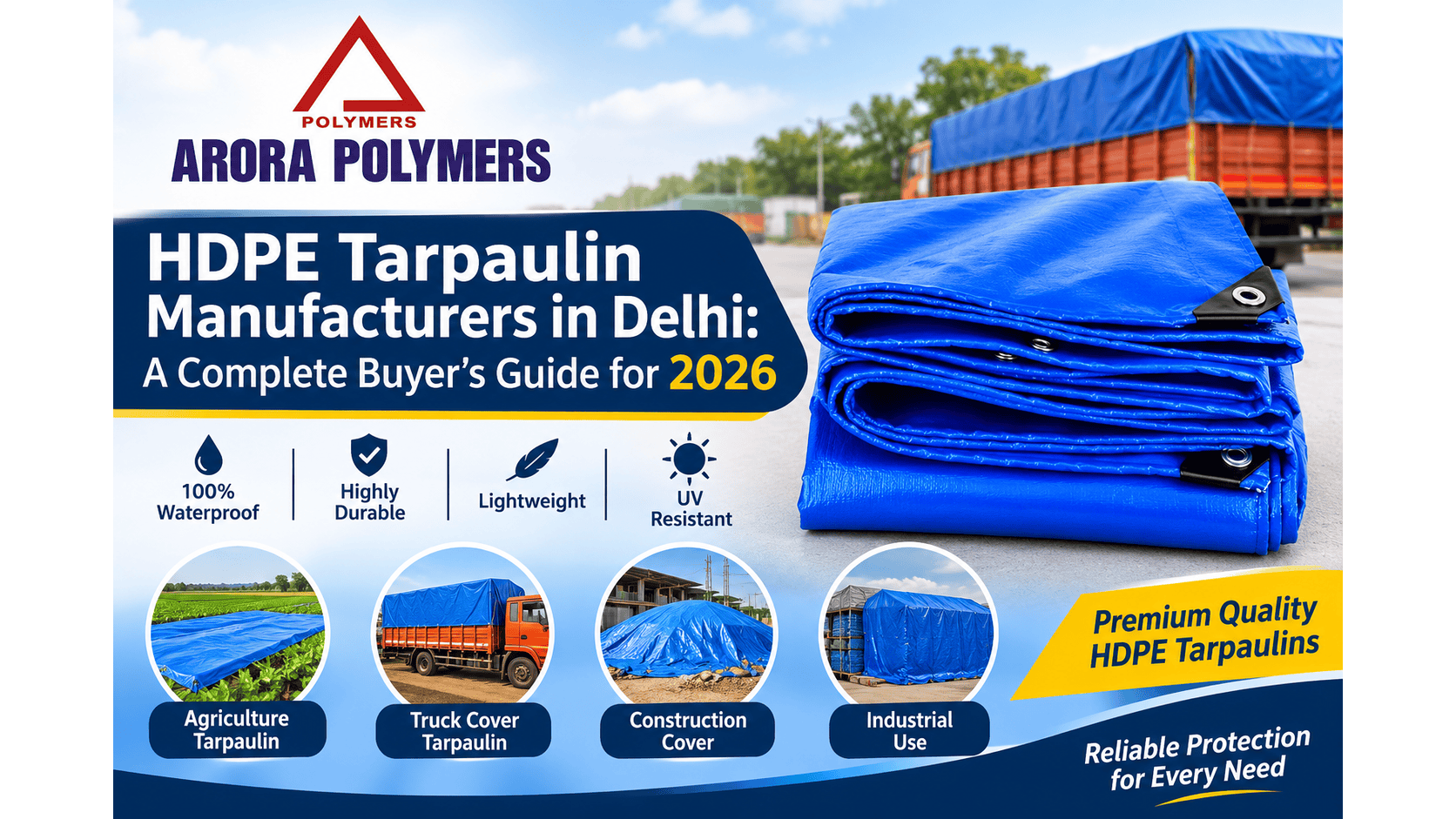
Finding the right tarpaulin manufacturer is important when your business depends on relieble protection against rain, sunlight, dust, and moisture and other mandatory situation. Whether you operate in agriculture, construction, transportation, warehousing, or manufacturing, choosing the right covering material can help protect valuable goods and reduce unnecessary replacement costs. This is why businesses increasingly prefer experienced HDPE Tarpaulin Manufacturers in Delhi that understand industrial requirements and offer products in different specifications.
HDPE (High-Density Polyethylene) tarpaulins are widely used because of their lightweight construction, flexibility, strength, and water-resistant properties. Manufactured using woven HDPE fabric with a protective laminated surface, these sheets are suitable for covering agricultural produce, construction materials, machinery, vehicles, and stored goods. Their availability in different GSM options, sizes, and colours makes them a practical solution for various commercial and industrial applications.
However, not every tarpaulin offers the same performance. Factors such as raw material quality, weaving strength, GSM, lamination, UV protection, and finishing determine whether a product is suitable for a particular application. Therefore, buyers should evaluate product specifications instead of making purchasing decisions based only on price.
Arora Polymers, an experienced name in the HDPE tarpaulin Manufacturers and woven sack industry, offers different tarpaulin solutions for commercial and industrial requirements. This buyer's guide explains the types of HDPE tarpaulins, their applications, important quality parameters, pricing factors, and what to check before selecting a manufacturer in 2026.
HDPE tarpaulins are protective sheets manufactured using High-Density Polyethylene, a strong and lightweight thermoplastic material. They generally consist of woven HDPE fabric coated or laminated with a protective layer to improve resistance to water and environmental exposure.
The woven structure contributes to the material's strength, while lamination helps create a protective surface. Depending on their specifications, these tarpaulins can be used for temporary covering, outdoor storage, transportation, agricultural protection, and industrial applications.
Professional HDPE Tarpaulin Manufacturers produce these sheets in different thicknesses, GSM specifications, colours, and dimensions to meet varying customer requirements.
Some important characteristics of HDPE tarpaulins include:
• Lightweight construction: Easy to handle, fold, transport, and store.
• Water resistance: Laminated surfaces help protect covered materials from moisture.
• Flexibility: Suitable for different covering and storage requirements.
• Strength: Woven construction provides useful tensile strength.
• UV protection: Specially formulated products can offer improved resistance to sunlight.
• Multiple sizes: Available in standard and customised dimensions, depending on manufacturing capabilities.
These characteristics make HDPE tarpaulins a popular choice for businesses that need economical and practical protective covering solutions.
The need for effective material protection continues across agriculture, infrastructure, logistics, and industrial sectors. Businesses require covering materials that are convenient to handle, suitable for outdoor conditions, and economical for regular use.
HDPE tarpaulins meet many of these requirements when selected according to the application.
Laminated HDPE tarpaulin Manufacturers are commonly used to cover agricultural produce, machinery, construction materials, and stored goods. Their water-resistant surface helps reduce direct exposure to rain and moisture.
Unlike many heavy covering materials, HDPE tarpaulins are relatively lightweight. Workers can fold, move, install, and store them with less effort, making them useful for businesses handling materials at multiple locations.
The woven HDPE fabric provides strength for general covering requirements. Product performance depends on fabric construction, material quality, GSM, lamination, and the conditions in which the sheet is used.
HDPE tarpaulins manufactured with suitable UV stabilisers can offer improved resistance to prolonged sunlight exposure. This makes them useful for agricultural storage, outdoor warehouses, transportation, and construction sites.
For businesses that require protective sheets in different sizes and quantities, HDPE tarpaulins offer a practical option. Selecting the right specifications can help achieve a balance between purchase cost and expected service life.
Before approaching HDPE Plastic Tarpaulin Manufacturers in Delhi, buyers should understand the available product varieties. Different tarpaulins are designed to meet different requirements, and the correct selection depends on the intended application.
HDPE laminated tarpaulins are manufactured using woven HDPE fabric with a laminated protective coating. This construction improves water resistance and makes the material suitable for covering goods in outdoor and indoor environments.
Common applications include agricultural storage, construction sites, industrial equipment covering, and transportation.
Blue HDPE tarpaulin sheets are widely used for general-purpose covering. They are suitable for temporary storage, construction materials, truck covering, and protecting goods from dust and rain.
Their availability in different GSM options and dimensions makes them useful for both commercial and industrial customers.
Superseal tarpaulins are specialised covering products available for customers requiring particular material and performance specifications. They can be considered for selected agricultural, industrial, and transportation applications.
Buyers should confirm the product's construction and intended use before ordering.
Bulltarp tarpaulins are another option for customers seeking protective covering materials for industrial and commercial requirements. Their suitability depends on fabric construction, material specifications, and environmental exposure.
Tuffseal tarpaulins are available for specialised covering requirements. Buyers can evaluate these products according to their required dimensions, material weight, application, and expected durability.
Arora Polymers offers different tarpaulin categories, including HDPE tarpaulin sheets, laminated tarpaulins, Superseal, Bulltarp, Tuffseal, and related products. Customers can explore the available options through the company's official website.
Purchasing a tarpaulin without checking its specifications can result in poor performance and additional expenses. Before finalising an order, buyers should evaluate the following factors.
GSM stands for Grams per Square Metre. It indicates the weight of the fabric per square metre and is an important specification when comparing different tarpaulin products.
Generally, higher-GSM materials contain more material per unit area, although GSM alone does not determine strength or durability.
Different GSM specifications may be suitable for different requirements:
| GSM range | Typical application |
| 80–100 GSM | Lightweight general covering |
| 110–150 GSM | Regular storage and agricultural use |
| 170–200 GSM | More demanding covering applications |
| 250–450 GSM | Selected heavy-duty applications |
These ranges are indicative. Always confirm the actual construction, specifications, and suitability with the manufacturer.
The quality of HDPE raw material plays an important role in the overall performance of a tarpaulin. Consistent material quality can contribute to better fabric construction and reliable product performance.
Buyers should ask manufacturers about the material grade and quality-control procedures followed during production.
Lamination helps protect the woven fabric from water penetration. The quality of the coating and finishing can influence the performance of the finished product.
If the tarpaulin will be used during rainy conditions, ask about its water-resistance specifications and suitability for continuous outdoor exposure.
Sunlight can gradually affect plastic materials, particularly when they are used outdoors for extended periods.
For applications involving regular sunlight exposure, buyers should ask whether the tarpaulin includes UV stabilisers and request information about its expected outdoor performance.
The woven construction contributes to the strength of an HDPE tarpaulin manufacturers. Consistent weaving and suitable fabric specifications are important for applications involving regular folding, handling, and installation.
Check the tensile strength and tear-resistance information wherever available.
Edge finishing and eyelets help secure the tarpaulin during installation. Poor finishing can cause damage around fastening points, especially when the material is exposed to wind or repeated handling.
Check eyelet quality, spacing, reinforcement, and overall finishing before placing a bulk order.
Different applications require different sheet dimensions. A standard tarpaulin may not always provide adequate coverage for large machinery, storage areas, trucks, or agricultural materials.
Discuss the required length, width, colour, GSM, and packaging with the manufacturer before confirming your order.
HDPE tarpaulins are used in several industries because they provide a convenient way to cover and protect materials. Their applications vary depending on product specifications and environmental conditions.
Agriculture is one of the major application areas for HDPE tarpaulins. Farmers and agricultural businesses use these sheets to cover harvested crops, grains, seeds, fertilisers, and farming equipment.
They can also be used for temporary storage and protecting agricultural materials during transportation. For outdoor agricultural applications, UV protection and suitable material weight should be considered.
Construction sites often store cement bags, sand, machinery, tools, and building materials in open areas. Suitable HDPE tarpaulin manufacturers help cover these materials and reduce their direct exposure to rain, dust, and sunlight.
Contractors can use these sheets for temporary material covering, equipment protection, and selected site applications.
Transportation companies require protective coverings to safeguard goods while they are being moved between locations.
HDPE tarpaulins are commonly used as truck covers and cargo covers. Their lightweight construction and availability in different dimensions make them practical for logistics and commercial transportation.
Manufacturing facilities and warehouses often need protective sheets for covering machinery, raw materials, finished products, and stored equipment.
The right tarpaulin can help reduce exposure to moisture, dust, and sunlight. Businesses should choose material specifications according to the storage environment and expected handling conditions.
Packaging companies and exporters use tarpaulins to cover goods during storage and transportation. These protective sheets can be useful for covering palletised materials and industrial products.
The correct size, strength, and fastening arrangement help provide suitable protection during handling and movement.
HDPE tarpaulins manufacturers are also used for temporary shelters, relief camps, and emergency covering arrangements. Their easy handling and flexible construction make them useful where quick installation is required.
However, the product should be selected according to the expected weather conditions and structural requirements.
Delhi is an important commercial market for plastic products, polymer materials, packaging solutions, and industrial supplies. Businesses searching for HDPE Tarpaulin Manufacturers in Delhi generally require suppliers who can provide suitable product specifications, bulk quantities, and dependable order coordination.
Working with an experienced manufacturer can offer several advantages:
• Product variety: Access to different GSM options, colours, sizes, and tarpaulin categories.
• Bulk supply: Solutions for wholesalers, distributors, contractors, and industrial customers.
• Customised specifications: Options for specific dimensions and product configurations, depending on manufacturing capabilities.
• Technical assistance: Guidance on selecting products according to their intended application.
• Quality consistency: Manufacturing processes and inspection procedures that support consistent product standards.
• Direct communication: Easier coordination regarding specifications, quotations, and order requirements.
However, buyers should always verify manufacturing capabilities, request product samples where possible, and confirm commercial terms before placing an order.
Selecting a suitable supplier requires more than comparing product prices. A reliable manufacturer should understand your requirements and clearly communicate the available specifications.
Consider these points when evaluating different manufacturers.
Manufacturing experience: Check the company's background, industry experience, and product specialisation.
Product portfolio: Review whether the manufacturer offers different tarpaulin categories and specifications.
Quality standards: Ask about raw material quality, weaving consistency, lamination, and inspection procedures.
Customisation facilities: Confirm whether the company can supply specific sizes, colours, GSM options, and packaging.
Bulk order capability: Wholesalers and distributors should check production capacity and order fulfilment arrangements.
Transparent pricing: A professional supplier should clearly explain product specifications, minimum order quantities, payment terms, and additional charges.
Customer communication: Responsive support makes it easier to discuss product requirements, repeat orders, and delivery schedules.
Comparing these factors can help you select a manufacturer that offers suitable products and dependable commercial support.
When comparing HDPE Tarpaulin Manufacturers in Delhi, buyers should consider the company's experience, product range, manufacturing capabilities, and ability to meet specific requirements.
Arora Polymers is an established name in the HDPE tarpaulin and woven sack industry, with experience dating back to 2004. The company offers different tarpaulin products for commercial and industrial applications.
Its product range includes:
• HDPE Tarpaulin Sheets
• HDPE Laminated Tarpaulins
• Superseal Tarpaulins
• Bulltarp Tarpaulins
• Tuffseal Tarpaulins
• Trustseal Tarpaulins
• Other related covering solutions
With experience in the HDPE tarpaulin and woven sack segment, Arora Polymers understands the importance of material specifications and application requirements.
Different industries require different types of protective coverings. The company's product portfolio gives customers options to explore according to their purchasing needs.
Arora Polymers offers tarpaulin options across different GSM specifications, including a listed range of 80 GSM to 450 GSM across its product categories. Buyers can discuss the appropriate specifications for their intended applications.
Standard sizes may not always meet industrial requirements. Arora Polymers provides customised solutions for HDPE tarpaulins and woven sacks according to customer specifications.
The company's product categories cater to requirements associated with agriculture, construction, transportation, packaging, roofing, and industrial covering.
Businesses interested in purchasing tarpaulins can visit https://arorapolymers.net/ to explore the product range and discuss their requirements.
The price of an HDPE tarpaulin manufacturers depends on its material specifications, dimensions, manufacturing requirements, and order quantity. Therefore, buyers should not expect a single fixed price for every product.
The following factors generally influence the cost:
| Pricing factor | Impact on price |
| GSM | Material weight influences material consumption |
| Raw material | Material grade affects production cost |
| Lamination | Coating specifications influence pricing |
| Dimensions | Larger sheets require more material |
| UV protection | Special stabilisation may affect cost |
| Customisation | Special sizes and colours may change pricing |
| Order quantity | Bulk orders may have different commercial rates |
| Transportation | Delivery location affects overall purchasing cost |
When comparing quotations from different HDPE Tarpaulin Manufacturers in Delhi, make sure the products have comparable specifications.
For example, a 150 GSM laminated tarpaulin and a 200 GSM tarpaulin may differ in construction, weight, and application suitability. Comparing them only by their quoted prices may lead to an incorrect purchasing decision.
Bulk buyers should also discuss minimum order quantities, packaging, transportation charges, payment terms, and delivery schedules before confirming an order.
HDPE and PVC tarpaulins are both used for protective covering, but they differ in material composition, weight, flexibility, and application suitability.
| Comparison | HDPE Tarpaulin | PVC Tarpaulin |
| Material | Woven HDPE with suitable coating | PVC-coated or laminated fabric |
| Weight | Generally lightweight | Often heavier |
| Handling | Easy to fold and transport | Depends on thickness and construction |
| Water resistance | Depends on lamination | Generally good |
| Applications | Agriculture, storage, transportation | Industrial covering, transport, and specialised uses |
| Cost | Depends on GSM and specifications | Depends on coating and construction |
HDPE tarpaulins are often preferred for lightweight, versatile, and economical covering applications. PVC tarpaulins may be more suitable where specific heavy-duty properties are required.
The right option depends on the intended use, environmental conditions, and budget.
Even experienced buyers can make mistakes when purchasing protective covering materials. Avoiding these issues can help improve product selection and reduce unnecessary expenses.
The cheapest product may not provide the required strength or performance. Always compare material quality, GSM, lamination, and finishing.
A tarpaulin suitable for temporary storage may not be appropriate for continuous outdoor industrial use. Explain your requirements clearly before selecting a product.
For outdoor applications, prolonged sunlight exposure can affect the material. Ask about UV stabilisation before placing an order.
If you are planning a large purchase, request a sample to evaluate the fabric, flexibility, lamination, and finishing.
Incorrect measurements can result in inadequate coverage or material wastage. Confirm the required dimensions before production or dispatch.
Bulk buyers should discuss order processing, packaging, transportation, and delivery schedules in advance.
HDPE tarpaulins continue to serve important requirements across India's agriculture, construction, logistics, packaging, and manufacturing sectors.
Agricultural businesses need protective sheets for crop storage and transportation. Construction companies require temporary coverings for building materials and machinery. Logistics providers use suitable tarpaulins to protect cargo, while industrial facilities require covering solutions for equipment and stored products.
As businesses focus on better storage practices, material protection, and efficient transportation, the need for suitable tarpaulin products remains relevant.
In 2026, buyers are also paying attention to product specifications, consistent manufacturing quality, customised requirements, and overall purchasing value.
Manufacturers that understand these requirements and provide clear product information can help businesses make better procurement decisions.
If you are a wholesaler, distributor, contractor, or industrial buyer, following a structured purchasing process can make ordering easier.
1. Identify your application: Decide whether the tarpaulin is required for agriculture, construction, transportation, storage, or packaging.
2. Select the GSM: Choose the appropriate material weight according to your requirements.
3. Confirm dimensions: Specify the required length, width, and other measurements.
4. Discuss product specifications: Ask about lamination, UV protection, colour, eyelets, and edge finishing.
5. Request a quotation: Share the required quantity and specifications to receive a suitable commercial offer.
6. Evaluate samples: Check product quality before confirming a large order.
7. Finalise delivery terms: Confirm payment conditions, packaging, transportation, and delivery schedules.
Clear communication with the manufacturer helps avoid confusion and ensures that the supplied product matches the agreed specifications.
HDPE tarpaulin manufacturers are versatile protective covering materials used across agriculture, construction, transportation, warehousing, and industrial sectors. Their lightweight construction, flexibility, and water-resistant properties make them a practical choice for businesses requiring reliable material protection.
However, selecting the right product requires careful consideration of GSM, raw material quality, lamination, UV protection, weaving strength, dimensions, and finishing.
When comparing HDPE Tarpaulin Manufacturers in Delhi, buyers should also evaluate manufacturing experience, product availability, customisation options, and customer support rather than focusing entirely on price.
Arora Polymers, with its experience in the HDPE tarpaulin and woven sack industry since 2004, offers different tarpaulin categories for commercial and industrial requirements. Whether you need HDPE tarpaulin sheets, laminated tarpaulins, Superseal, Bulltarp, or Tuffseal products, you can explore the available options and discuss your specifications directly with the company.
If you are planning to purchase HDPE tarpaulins in 2026, connect with Arora Polymers to discuss your requirements and identify a suitable covering solution for your business.
Explore the product range: https://arorapolymers.net/
1. What are HDPE tarpaulins and where are they commonly used?
HDPE tarpaulins are protective sheets made from High-Density Polyethylene woven fabric, generally laminated to improve water resistance. They are commonly used in agriculture, construction, transportation, warehousing, industrial storage, and packaging to protect goods from rain, dust, and sunlight.
2. Who are the best HDPE Tarpaulin Manufacturers in Delhi?
The best HDPE Tarpaulin Manufacturers in Delhi are those offering consistent material quality, different GSM options, customised sizes, reliable product specifications, and bulk supply facilities. Arora Polymers is an established manufacturer and supplier offering HDPE tarpaulins and related covering solutions for commercial and industrial requirements.
3. What is the ideal GSM for HDPE tarpaulins?
The ideal GSM depends on the intended application. Lightweight tarpaulins may be suitable for general covering, while higher-GSM options are often preferred for demanding industrial and outdoor applications. Buyers should also consider weaving strength, lamination, and UV protection before selecting a product.
4. Are HDPE tarpaulins waterproof and suitable for outdoor use?
Laminated HDPE tarpaulins are designed to provide water resistance and are commonly used for outdoor covering applications. Products with suitable UV stabilisation can also offer improved resistance to sunlight. Their performance depends on material quality, lamination, seams, and environmental conditions.
5. What factors affect the price of HDPE tarpaulins in Delhi?
HDPE tarpaulin prices depend on GSM, raw material quality, sheet dimensions, lamination, UV protection, colour, customisation, and order quantity. Buyers should compare quotations using the same product specifications to identify the most suitable option.
6. What is the difference between HDPE and PVC tarpaulins?
HDPE tarpaulins are generally manufactured using woven polyethylene fabric with a protective coating, making them lightweight and flexible. PVC tarpaulins use PVC-coated or laminated fabric and are often heavier. The right choice depends on the required strength, application, environmental exposure, and budget.
7. Can HDPE tarpaulins be customised in different sizes and GSM?
Yes, HDPE tarpaulins can be available in different dimensions, GSM specifications, and colours, depending on the manufacturer's capabilities. Businesses can discuss their specific requirements with manufacturers to find suitable products for agricultural, commercial, and industrial applications.
8. How can I identify reliable HDPE Plastic Tarpaulin Manufacturers in Delhi?
Check the manufacturer's industry experience, product range, raw material quality, weaving standards, lamination, customisation facilities, and bulk order capacity. Request product samples and confirm delivery terms before placing a large order.
9. Why are HDPE tarpaulins preferred for agriculture and construction?
HDPE tarpaulins are preferred because they are lightweight, easy to handle, and available in different specifications. They can be used to cover harvested crops, construction materials, machinery, and stored goods, helping reduce exposure to rain, dust, and sunlight.
10. Why choose Arora Polymers for HDPE tarpaulin requirements?
Arora Polymers has experience in the HDPE tarpaulin and woven sack industry dating back to 2004. The company offers products such as HDPE tarpaulin sheets, laminated tarpaulins, Superseal, Bulltarp, and Tuffseal, along with customised solutions for commercial and industrial requirements.